The valley is situtated at an altitude of 1336 meter above sea level and covers an area of 218 sq miles. The rich tapestry of the culture heritage of Nepal is synthesized in the Kathmandu valley, the home of the ancient and sophisticated Newari culture. The Newars are the indigenous inhabitants of the valley and the creators of the splendid civilizations of its three cities – Kathmandu, Patan and Bhaktapur. The skillfully-built temples and places, delicately-engraves stone and metal images, carved wooden columns and pillars, and the history laden shrines and chaityas of these three historical cities stand testimony to the Newar’s artistic achievements.
Changu Narayan; Situated at the end of a long ridge runs well into the Valley, it is said to have been built by King Hari Dutta in 323 AD and said to be the oldest temple in the Valley. It was listed in the UNESCO World Heritage Monument List in 1979. You can make a day trip and visit also Bkaktapur.
Dashain or Durga Puja; The Dashain festival is the most important festival of the Nepalese. The entire country is in enthusiastic holiday mood at the time of the festival. Dashain is the longest and the most auspicious festival in the Nepalese annual calendar, celebrated by Nepalese of all caste and creed throughout the country. The fifteen days of celebration occurs during the bright lunar fortnight ending on the day of the full moo
Gaijatra;
The festival of "Gai Jatra" (the procession of cows) which is one of the most popular festivals, is generally celebrated in the Nepalese month of Bhadra (August-September).This festival has its roots in the belief that the god of death, Yamaraj, must be feared and hence worshipped.
Ghode Jatra
Ghode Jatra, the Horse Racing Day falls on Darhsa Shrad Aunsi of the month Chaitra (March/April). A grand horse parade takes place at Tundikhel, the central point of the city reputed to have been in the former days the largest parade ground in Asia.
Thursday, August 12, 2010

FESTIVAL OF NEPAL WITH DIFFERENT DATE
Dashain Holidays;
During the month of Kartik in the Bikram Sambat calendar (late September and early October), the Nepalese people indulge in the biggest festival of the year, Dashain. Dashain is the longest and the most auspicious festival in the Nepalese annual calendar, celebrated by Nepalese of all caste and creed throughout the country. The fifteen days of celebration occurs during the bright lunar fortnight ending on the day of the full moon.
Maghe Sankranti;
Maghe Sankranti is the beginning of the holy month of Magh, usually the mid of January. It brings an end to the ill-omened month of Poush (mid-december) when all religious ceremonies are forbidden. Even if it is considered the coldest day of the year, it marks the coming of warmer weather and better days of health and fortune.
Maha Shiva Ratri;
This day is the celebration dedicated to the Lord Shiva which falls on the Trayodashi of the month Fagun (February/March).


During the month of Kartik in the Bikram Sambat calendar (late September and early October), the Nepalese people indulge in the biggest festival of the year, Dashain. Dashain is the longest and the most auspicious festival in the Nepalese annual calendar, celebrated by Nepalese of all caste and creed throughout the country. The fifteen days of celebration occurs during the bright lunar fortnight ending on the day of the full moon.
Maghe Sankranti;
Maghe Sankranti is the beginning of the holy month of Magh, usually the mid of January. It brings an end to the ill-omened month of Poush (mid-december) when all religious ceremonies are forbidden. Even if it is considered the coldest day of the year, it marks the coming of warmer weather and better days of health and fortune.
Maha Shiva Ratri;
This day is the celebration dedicated to the Lord Shiva which falls on the Trayodashi of the month Fagun (February/March).


FESTIVAL OF NEPAL WITH DIFFERENT DATE
Mata Tirtha Snan (Mother's Day) ;
This is one of the widely celebrated festivals that falls on the first month, Baisakh (April/May), of the Nepali Year.It is also called Mata Tirtha Aunsi as it falls on a new moon night.
Buddha Jayanti ;
This day is celebrated to mark the birthday of the Lord Buddha which dates back in about 543 BC.It falls on Jestha Purnima (Full moon night).
Janai Purnima,Rakshya Bandhan,Khumbeshwor Mela Patan;
Janai Purnima is the festival of Sacred Thread. On this day every Hindu ties a sacred thread on the wrist. It is also called Rakshya Bandhan.On this day, there is a big Mela (fair) at Khumbeshwor; Lalitpur.It is again on a full moon night.
Gaijatra;
The festival of "Gai Jatra" (the procession of cows) which is one of the most popular festivals, is generally celebrated in the Nepalese month of Bhadra (August-September).This festival has its roots in the belief that the god of death, Yamaraj, must be feared and hence worshipped.
Shree Krishna Janmastami;
Sri Krishna Janmastami marks the celebration of the birth of Lord Sri Krishna. This festival is also known as Krishna Jayanti or Janmashtami. Lord Krishna is regarded as the 8th avatar or 'incarnation' of Lord Vishnu.It falls on Saptami of Bhadra (August/September).
Indrajatra(Holiday Only in Kathmandu);
This festival falls in the end of Bhadra (August/September). Both Hindus and Buddhists unite to celebrate the festival of Indra Jatra with great enthusiasm.
Ghode Jatra;
Ghode Jatra, the Horse Racing Day falls on Darhsa Shrad Aunsi of the month Chaitra (March/April). A grand horse parade takes place at Tundikhel, the central point of the city reputed to have been in the former days the largest parade ground in Asia.
This is one of the widely celebrated festivals that falls on the first month, Baisakh (April/May), of the Nepali Year.It is also called Mata Tirtha Aunsi as it falls on a new moon night.
Buddha Jayanti ;
This day is celebrated to mark the birthday of the Lord Buddha which dates back in about 543 BC.It falls on Jestha Purnima (Full moon night).
Janai Purnima,Rakshya Bandhan,Khumbeshwor Mela Patan;
Janai Purnima is the festival of Sacred Thread. On this day every Hindu ties a sacred thread on the wrist. It is also called Rakshya Bandhan.On this day, there is a big Mela (fair) at Khumbeshwor; Lalitpur.It is again on a full moon night.
Gaijatra;
The festival of "Gai Jatra" (the procession of cows) which is one of the most popular festivals, is generally celebrated in the Nepalese month of Bhadra (August-September).This festival has its roots in the belief that the god of death, Yamaraj, must be feared and hence worshipped.
Shree Krishna Janmastami;
Sri Krishna Janmastami marks the celebration of the birth of Lord Sri Krishna. This festival is also known as Krishna Jayanti or Janmashtami. Lord Krishna is regarded as the 8th avatar or 'incarnation' of Lord Vishnu.It falls on Saptami of Bhadra (August/September).
Indrajatra(Holiday Only in Kathmandu);
This festival falls in the end of Bhadra (August/September). Both Hindus and Buddhists unite to celebrate the festival of Indra Jatra with great enthusiasm.
Ghode Jatra;
Ghode Jatra, the Horse Racing Day falls on Darhsa Shrad Aunsi of the month Chaitra (March/April). A grand horse parade takes place at Tundikhel, the central point of the city reputed to have been in the former days the largest parade ground in Asia.
DIFFERENT FESTIVAL IN DIFFERENT REGION
CHHAT: This festival is celebrated in terai region in different place. This festival is the most famous festival in terai region and also people worships the god with joyfully and heartly, and also the biggest festival in terai region. This festival is specially worships by married women not unmarried.chhat is one of the most popular festival in terai region so people are buy new types of clothes and sweets and other new equipments that believes that new things helps to bring happy and peace in the family.
If you asked me about chhat festival that why this festival is celebrated than I am unable to explain this festival in briefly but I want to give some information about this .this festival is celebrated for the family and for the happy life, now some also people said that CHHATIMATAHA (mighty god) helps from different problem and also helps in economy background of the family. In this festival there are different types of fruits ,sweets,sugarcan,banana leaf and other types of equipments are needed to worship this god than only god will happy and protect from different problem.
If you asked me about chhat festival that why this festival is celebrated than I am unable to explain this festival in briefly but I want to give some information about this .this festival is celebrated for the family and for the happy life, now some also people said that CHHATIMATAHA (mighty god) helps from different problem and also helps in economy background of the family. In this festival there are different types of fruits ,sweets,sugarcan,banana leaf and other types of equipments are needed to worship this god than only god will happy and protect from different problem.
Tiji Festival in Mustang 2010
Mustang trek lying in the rain shadow of the Himalayas is perhaps the last enclave of pristine Tibetan culture. Forbidden & isolated from the rest of the World it was able to evolve its own distinctive culture and traditional which is so rich & unique. Lo-Mustang, the capital is walled city ruled by religious king. Untouched by modern civilization, life in Mustang goes on as it has for centuries in unhurried pace. A trek into the kingdom of Mustang is an unforgettable experience. Upper Mustang is restricted area of Nepal. Who wish to visit Mustang, Have to pay special permit fee and apply for permit any Gov. Resister trekking agency in Nepal.
The Tiji festival is a three-day ritual known as "The chasing of the Demons" and it is centered around the Tiji myth. Tiji tells the story of a deity named Dorje Jono who must battle against his demon father to save the Kingdom of Mustang from destruction. The demon father wreaks havoc on Mustang by creating a water shortage which, in this extremely arid land, is the most precious life-sustaining resource. Dorje Jono eventually defeats the demon and banishes him from the land.
Tiji is a celebration and reaffirmation of this myth. Throughout the festival the events and story of the myth are re-enacted. The festival is timed to coincide with the end of the dry season (late winter/spring) and ushers in the wetter monsoon season. Tiji comes from the words "ten che" meaning "the hope of Buddha Dharma prevailing in all worlds" and is a spring renewal festival that also celebrates the triumph of good over evil. In 1964 Michel Peissel was the first westerner to observe the Tiji festival. At this time, the Mustang region was still completely closed off to foreigners and he had to obtain special permission from the government of Nepal in order to enter the region. Despite his arrival on the last day of the celebration (he was unaware of the observance of Tiji) the experience left a lasting impression on him. "The scenes I witnessed were so extraordinary and so unexpected that I dared not believe my eyes and even today I have some trouble in believing in the reality of what I saw that day."
The Tiji festival is a three-day ritual known as "The chasing of the Demons" and it is centered around the Tiji myth. Tiji tells the story of a deity named Dorje Jono who must battle against his demon father to save the Kingdom of Mustang from destruction. The demon father wreaks havoc on Mustang by creating a water shortage which, in this extremely arid land, is the most precious life-sustaining resource. Dorje Jono eventually defeats the demon and banishes him from the land.
Tiji is a celebration and reaffirmation of this myth. Throughout the festival the events and story of the myth are re-enacted. The festival is timed to coincide with the end of the dry season (late winter/spring) and ushers in the wetter monsoon season. Tiji comes from the words "ten che" meaning "the hope of Buddha Dharma prevailing in all worlds" and is a spring renewal festival that also celebrates the triumph of good over evil. In 1964 Michel Peissel was the first westerner to observe the Tiji festival. At this time, the Mustang region was still completely closed off to foreigners and he had to obtain special permission from the government of Nepal in order to enter the region. Despite his arrival on the last day of the celebration (he was unaware of the observance of Tiji) the experience left a lasting impression on him. "The scenes I witnessed were so extraordinary and so unexpected that I dared not believe my eyes and even today I have some trouble in believing in the reality of what I saw that day."
SOME FAMOUS FESTIVAL CELEBRATE IN KATHMANDU VALLEY
The valley is situtated at an altitude of 1336 meter above sea level and covers an area of 218 sq miles. The rich tapestry of the culture heritage of Nepal is synthesized in the Kathmandu valley, the home of the ancient and sophisticated Newari culture. The Newars are the indigenous inhabitants of the valley and the creators of the splendid civilizations of its three cities – Kathmandu, Patan and Bhaktapur. The skillfully-built temples and places, delicately-engraves stone and metal images, carved wooden columns and pillars, and the history laden shrines and chaityas of these three historical cities stand testimony to the Newar’s artistic achievements.
Changu Narayan; Situated at the end of a long ridge runs well into the Valley, it is said to have been built by King Hari Dutta in 323 AD and said to be the oldest temple in the Valley. It was listed in the UNESCO World Heritage Monument List in 1979. You can make a day trip and visit also Bkaktapur.
Dashain or Durga Puja; The Dashain festival is the most important festival of the Nepalese. The entire country is in enthusiastic holiday mood at the time of the festival. Dashain is the longest and the most auspicious festival in the Nepalese annual calendar, celebrated by Nepalese of all caste and creed throughout the country. The fifteen days of celebration occurs during the bright lunar fortnight ending on the day of the full moo
Gaijatra;
The festival of "Gai Jatra" (the procession of cows) which is one of the most popular festivals, is generally celebrated in the Nepalese month of Bhadra (August-September).This festival has its roots in the belief that the god of death, Yamaraj, must be feared and hence worshipped.
Ghode Jatra
Ghode Jatra, the Horse Racing Day falls on Darhsa Shrad Aunsi of the month Chaitra (March/April). A grand horse parade takes place at Tundikhel, the central point of the city reputed to have been in the former days the largest parade ground in Asia.
Changu Narayan; Situated at the end of a long ridge runs well into the Valley, it is said to have been built by King Hari Dutta in 323 AD and said to be the oldest temple in the Valley. It was listed in the UNESCO World Heritage Monument List in 1979. You can make a day trip and visit also Bkaktapur.
Dashain or Durga Puja; The Dashain festival is the most important festival of the Nepalese. The entire country is in enthusiastic holiday mood at the time of the festival. Dashain is the longest and the most auspicious festival in the Nepalese annual calendar, celebrated by Nepalese of all caste and creed throughout the country. The fifteen days of celebration occurs during the bright lunar fortnight ending on the day of the full moo
Gaijatra;
The festival of "Gai Jatra" (the procession of cows) which is one of the most popular festivals, is generally celebrated in the Nepalese month of Bhadra (August-September).This festival has its roots in the belief that the god of death, Yamaraj, must be feared and hence worshipped.
Ghode Jatra
Ghode Jatra, the Horse Racing Day falls on Darhsa Shrad Aunsi of the month Chaitra (March/April). A grand horse parade takes place at Tundikhel, the central point of the city reputed to have been in the former days the largest parade ground in Asia.
MAIN FESTIVALS OF NEPAL
When we are talking about festival of Nepal than I would like to express the different types of festival celebrating in Nepal. So, firstly I would like to express my felling and some information about DASHAIN and TIHAR. The best part about the festivals in Nepal is that all the events are celebrated with the same enthusiasm and galore the way it used to be hundreds of years ago when people had no other means of entertainment.
Dashain (Bijaya Dashami): During the month of Kartik (late September and early October), the Nepalese people indulge in the biggest festival of the year, Dashain. Dashain is the longest and the most auspicious festival in the Nepalese annual calendar, celebrated by Nepalese of all caste and creed throughout the country. The fifteen days of celebration occurs during the bright lunar fortnight ending on the day of the full moon. Thorough out the kingdom of Nepal the goddess Durga in all her manifestations are worshiped with innumerable pujas, abundant offerings and thousands of animal sacrifices for the ritual holy bathing, thus drenching the goddess for days in blood. Read more about Dashain Festival.In this festival all neplease share their happiness and sadness’ among them and enjoy this festival happily.
TIHAR (The Festival of Lights):
Tihar, the Nepalese festival, is compared by many with the Deepawali festival of India. The purpose of celebration is to worship Goddess Laxmi. According to Hindu scriptures, Laxmi is the Goddess of Wealth. The devotees lit oil lamps and candles to illuminate their homes. Kathmandu dons the look of a sparkling diamond on Tihar. The festival is celebrated for five days beginning from the thirteenth day of the waning moon in the month of October.
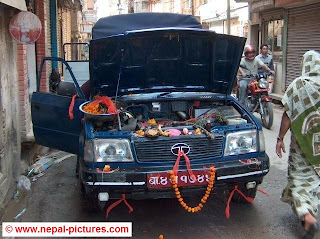


Dashain (Bijaya Dashami): During the month of Kartik (late September and early October), the Nepalese people indulge in the biggest festival of the year, Dashain. Dashain is the longest and the most auspicious festival in the Nepalese annual calendar, celebrated by Nepalese of all caste and creed throughout the country. The fifteen days of celebration occurs during the bright lunar fortnight ending on the day of the full moon. Thorough out the kingdom of Nepal the goddess Durga in all her manifestations are worshiped with innumerable pujas, abundant offerings and thousands of animal sacrifices for the ritual holy bathing, thus drenching the goddess for days in blood. Read more about Dashain Festival.In this festival all neplease share their happiness and sadness’ among them and enjoy this festival happily.
TIHAR (The Festival of Lights):
Tihar, the Nepalese festival, is compared by many with the Deepawali festival of India. The purpose of celebration is to worship Goddess Laxmi. According to Hindu scriptures, Laxmi is the Goddess of Wealth. The devotees lit oil lamps and candles to illuminate their homes. Kathmandu dons the look of a sparkling diamond on Tihar. The festival is celebrated for five days beginning from the thirteenth day of the waning moon in the month of October.


Subscribe to:
Posts (Atom)